
Puppy Potty Training. Your Dog Still Does It at Home
Post Date:
November 7, 2023
(Date Last Modified: November 13, 2025)
When a puppy continues to eliminate indoors, a focused assessment and stepwise adjustments help identify whether the cause is training, medical, or situational so you can respond appropriately. Practical changes in supervision, cleanup, scheduling, and veterinary evaluation are commonly needed.
Quick assessment of the problem
Determine whether accidents are incomplete housetraining, medical, marking, or situational relapse so the next steps match the cause.
- Keep a written log for at least 7 days that records time, room, and what the puppy was doing before each incident [1].
- Note whether the event involved urine or feces and whether the void was a small dribble or a full stream [2].
- Record patterns such as accidents within about 15 minutes of waking, play, or arrival of visitors [2].
Use the log to identify repeating locations, times of day, and triggers so you can separate behavioral patterns from medical or management causes.
Rule out medical causes
Treating any underlying health problems is essential before changing training expectations.
Common medical causes include urinary tract infection, gastrointestinal upset, intestinal parasites, and congenital bladder or neurologic issues; consider these regardless of age [3].
If accidents are frequent or sudden in a previously reliable puppy, request a urinalysis with culture, a fecal parasite test, and baseline bloodwork from your veterinarian to screen for infection or metabolic reasons [3].
Medication side effects and age-related bladder control can play a role; puppies younger than about 6 months may have more frequent involuntary voids due to developmental control [3].
Common behavioral and developmental reasons
Understanding why puppies regress or eliminate indoors guides humane behavioral responses.
Bladder maturation is gradual; a useful rule of thumb is that very young puppies often need breaks far more frequently than adults, and some puppies show adolescent regression during hormonal and social development [4].
Anxiety, fear, or overstimulation can trigger submissive or excitement elimination; marking is typically small-volume urine in vertical locations and may increase around new people or animals in the household [2].
Immediate cleanup and scent removal
Removing odor thoroughly prevents the puppy from returning to the same spot to eliminate again.
Use an enzymatic cleaner formulated for pet urine and avoid ammonia-based cleaners that can smell similar to urine and attract repeat soiling [2].
Wash or remove contaminated rugs and soft toys promptly; for launderable items use the hottest washer setting safe for the fabric and an enzymatic additive if available [1].
Block off or restrict access to previously soiled areas until the puppy is reliably housebroken there.
Resetting and simplifying the training plan
A brief, clear reset reduces confusion and speeds relearning for both puppy and household members.
Start with short-term confinement and constant supervision: keep the puppy within sight or on a tether for most awake hours, and immediately take the puppy outside when you notice signs of needing to eliminate [2].
Re-establish a consistent exit routine: use the same door, cue word, and a calm transition to the outdoor spot so the puppy learns the context for elimination [4].
Keep a training log that tracks outings, treats, and accidents and set realistic relearning timeframes—expect measurable improvement over days to weeks rather than overnight change [3].
Crate and confinement strategies
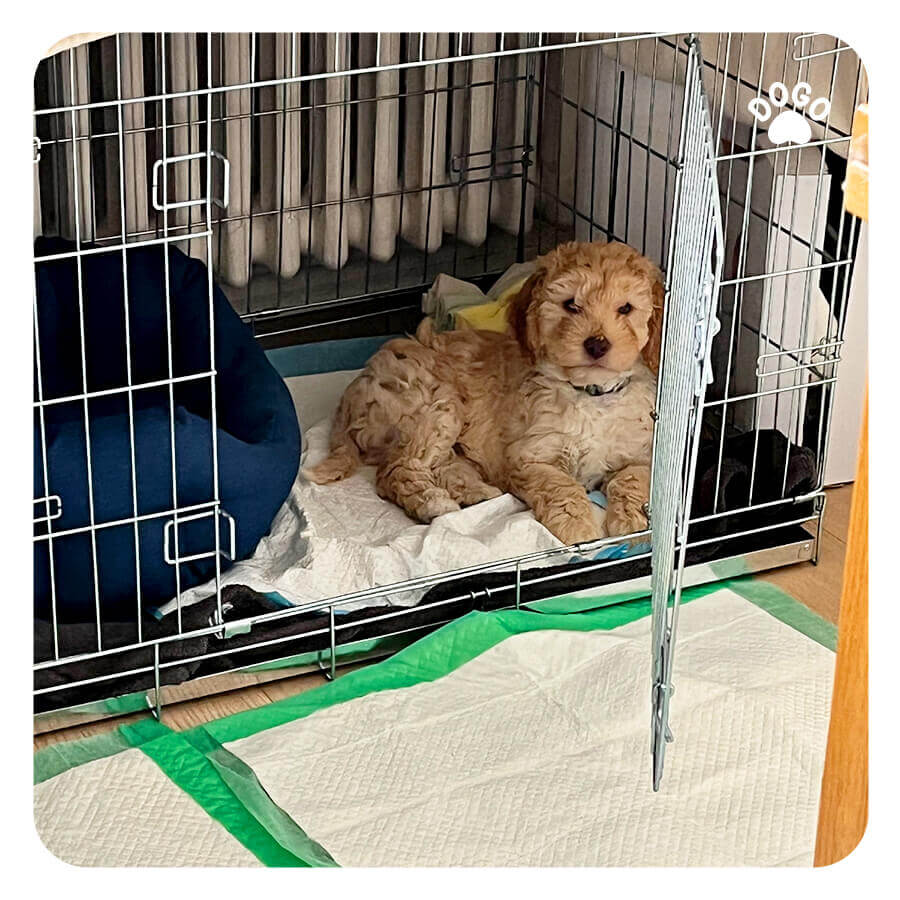
When used correctly, a crate helps build bladder control and prevents unsupervised accidents while the puppy learns.
Choose a crate size that lets the puppy stand, turn, and lie down comfortably; for small breeds a crate often ranges from about 24–36 in (61–91 cm) and for medium breeds 36–42 in (91–107 cm) depending on adult size [2].
Increase crate time gradually and provide scheduled bathroom breaks; very young puppies should not be expected to hold for extended periods and need more frequent access to elimination areas [4].
At night limit unsupervised intervals and offer a final outdoor break before sleep; provide safe chew toys or long-lasting treats to prevent boredom and destructive behavior during crate time [2].
Scheduled feeding, watering, and potty breaks
Predictable intake leads to predictable elimination windows and more reliable outings.
Many veterinarians and feeding guidelines recommend scheduled meals rather than ad lib feeding; for most puppies this means three feedings per day until about 6 months, then transitioning to two feedings per day [3].
Water needs for dogs are commonly estimated around 60 mL/kg/day as a maintenance starting point, with adjustments for activity and environment; use mL/kg/day when calculating fluid management for puppies [4].
Take the puppy outside shortly after meals—typically within about 5–30 minutes of eating—and also after play sessions, naps, and waking to capitalize on predictable elimination times [4].
Positive reinforcement and humane corrections
Reward-based methods teach desired behavior quickly and avoid fear-based setbacks that can worsen elimination problems.
Praise and deliver a small high-value treat immediately after the puppy eliminates outdoors; timing within one to two seconds helps the puppy link the reward to the action [2].
Use a consistent brief marker word at the moment of elimination, then follow with a reward; avoid scolding after an indoor accident because puppies typically do not connect delayed punishment with the act [3].
Redirect to an appropriate spot if you catch the puppy in the act, and consider a short supervised time-out (not prolonged isolation) only when necessary to interrupt behavior.
Troubleshooting specific setbacks
Different causes need targeted fixes for marking, separation issues, multi-dog households, or relapse after progress.
For marking, reduce access to vertical surfaces, clean thoroughly with enzymatic products, and use supervised outdoor outings combined with reward-based reinforcement for appropriate elimination sites [1].
If separation anxiety is suspected, gradual desensitization and environmental enrichment reduce stress-related elimination; consult a behaviorist or veterinarian for structured plans including management of intense cases [3].
When multiple people care for the puppy, standardize cues, timing, and rewards so the puppy receives consistent messages about where and when to eliminate [2].
Transitioning to long-term freedom and prevention
Gradually increasing freedom while maintaining some structure prevents backsliding as the puppy matures.
Phase access to rooms over weeks: add one controlled area at a time and monitor for at least several days of accident-free behavior before expanding unsupervised access [4].
Continue occasional refresher sessions and reinforce outdoor elimination with praise on a maintenance schedule; expect adolescent shifts in behavior and reintroduce stricter supervision during those periods [3].
Plan for seasonal, household, or health changes that can alter elimination patterns and keep the log habit for quick troubleshooting if accidents reappear.
Practical timing table for outings
| Age | Suggested max time between breaks | Typical breaks per day |
|---|---|---|
| 8–12 weeks | 1–2 hours [5] | 10–14 times [4] |
| 3–4 months | 2–3 hours [4] | 8–10 times [3] |
| 5–6 months | 3–4 hours [4] | 6–8 times [3] |
| Adult reliable | 4–8 hours depending on individual control [4] | 4–6 times [3] |
Sources
- merckvetmanual.com — veterinary reference and clinical guidance.
- avma.org — American Veterinary Medical Association guidance on behavior and care.
- aaha.org — American Animal Hospital Association feeding and preventive care recommendations.
- vcahospitals.com — veterinary hospital resources on housetraining, crate use, and hydration.
- cdc.gov — public health guidance on parasites and zoonotic risks relevant to puppy health and fecal testing.
