
Play with Your Dog at Home
Post Date:
November 12, 2023
(Date Last Modified: November 13, 2025)
Ideas and practical approaches to playing with a dog at home, organized by style, safety, and adaptability for different ages and energy levels.
Benefits of Play at Home
Regular play supports physical conditioning, mental engagement, and a stronger relationship between handler and dog. Aim for at least 30 minutes of moderate activity per day for an average adult dog to help maintain lean body condition and cardiovascular health[1].
Mental stimulation through brief problem-solving or scent games can reduce boredom-related behaviors such as excessive chewing or vocalizing, with structured cognitive sessions as short as 10–15 minutes producing measurable behavioral improvements in many dogs[2].
Using play as part of routine interactions builds predictable, positive exchanges that enhance trust and social bonding between people and dogs, particularly when play is paired with consistent, calm handling and clear signals[2].
Know Your Dog’s Play Style
Assess energy level by monitoring typical daily activity; many adult dogs fall into low, moderate, or high energy categories, where low-energy dogs may benefit from 10–20 minutes of focused play per session, moderate dogs 20–40 minutes, and high-energy dogs multiple 15–30 minute sessions per day[3].
Identify prey or chase drive by offering different toy types: some dogs show a clear preference for fast-moving, small toys while others prefer large tug items; matching games to these preferences reduces frustration and increases engagement[4].
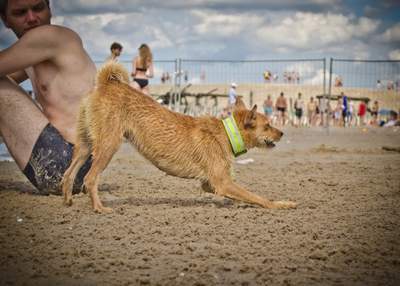
Recognize common play signals such as play bows, loose wagging, and exaggerated mouth movements, and watch for escalation signs like stiff body posture, fixed stare, or rapid hard lunges; responding to early calming signals prevents conflicts and over-arousal[2].
Safety and Home Preparation
Clear a play area of breakables, dangling cords, and low furniture with sharp edges; a minimum clear space of about 6 ft by 6 ft (1.8 m by 1.8 m) is useful for many indoor games with small to medium dogs[4].
- Choose toys at least 1.5–2 times the diameter of a dog’s mouth to reduce choking risk, and discard toys with loose seams or exposed stuffing[3].
- Prefer durable rubber or tightly woven fabric for chewers, and replace toys after visible damage to prevent ingestion hazards[3].
- Supervise high-value play and store toys out of reach between sessions to keep novelty and reduce the chance of resource guarding[2].
Consider flooring: non-slip mats or rugs reduce the risk of slipping on hard surfaces, and use baby gates to limit access to stairs or open doors during energetic play[3].
Short, Low-Impact Indoor Games
Hide-and-seek with treats or with a handler can be run in short rounds of 5–10 minutes to provide mental and mild physical stimulation without heavy impact[5].
Nose work-style scent games involve hiding a favored treat or toy in 3–6 locations per session and asking the dog to find each spot; a single round can last 5–15 minutes depending on the dog’s focus and stamina[2].
Gentle tug and brief indoor fetch alternatives—using soft toys and limiting tug rounds to 10–20 seconds—help older or low-energy dogs play without repetitive impact on joints[5].
High-Energy Indoor Activities
Flirt pole or controlled chase games are effective for high-drive dogs when used in short intervals; perform 3–6 chase bouts of 30–60 seconds with rest breaks between bouts to avoid over-exertion and overheating[4].
Stair or hallway fetch can be used cautiously: limit stair fetch to 6–10 throws per session and avoid for growing puppies or dogs with orthopedic issues to reduce injury risk[3].
Indoor agility drills such as low jumps (set under 12 in (30 cm) for most small or medium dogs) and short weave sequences can be arranged in 10–15 minute sessions that alternate high exertion with rest to mimic interval training[1].
Mental Enrichment and Puzzle Play
Food-dispensing toys and puzzle feeders can slow eating and provide 10–30 minutes of cognitive work per feeding event, reducing stress and improving mealtime enrichment[1].
Scent work and trial-style tracking games that involve short, graduated problem difficulty help dogs generalize search skills; start with a 3–5 step sequence and increase to 8–12 steps for experienced dogs[2].
Rotate puzzle complexity and reinforcement schedules so that roughly 40–60 percent of sessions include variable reinforcement or harder puzzles to maintain engagement and prevent extinction of search behavior[4].
Play-Based Training and Reinforcement
Use play as a high-value reward for reliable recall by offering 5–10 second play rewards immediately after the dog returns to handler; short, contingent play preserves the value of the reward and speeds learning[2].
Impulse-control games such as “leave it” followed by a 5–20 second structured turn for a toy teach delayed reinforcement, and repeating short exercises 5–15 times per session supports impulse control gains[2].
Combine cues with toy-based reinforcement by offering 3–7 quick repetitions of a trained behavior followed by a play bout to build reliable transitions between obedience and play contexts[4].
DIY Toys and Simple Agility Setups
Safe DIY toy ideas include a rinsed plastic bottle inside a braided fabric sleeve for sound-based interest (supervise for wear), a muffin-tin treat puzzle covered with tennis balls for simple problem-solving, and braided fleece tugs for gentle tug play; replace or retire any DIY item showing damage[3].
Lightweight, space-efficient agility setups can use collapsible tunnels of 24–36 in (60–90 cm) diameter for small to medium dogs and low crossbars set at 6–12 in (15–30 cm) height to start; increase height gradually as skill and joint tolerance allow[1].
Rotate toys weekly and inspect all items monthly for tears, sharp edges, or exposed parts; discard anything that could be swallowed or that creates frayed strands small enough to be ingested[3].
Adapting Play for Age, Health, and Breed
Puppy socialization and bite-inhibition play should emphasize short sessions of 5–10 minutes with many supervised rest breaks and controlled handling to avoid overstimulation of developing joints[5].
Senior or injured dogs benefit from low-impact sessions of 5–15 minutes focusing on balance, controlled fetch with soft targets, and scent work rather than high-speed chases; adjust frequency rather than duration if stamina is limited[5].
Breed-specific enrichment leverages innate tendencies: hounds often enjoy scent trails and long, low-intensity searches, terriers may prefer short, vigorous tug or prey-type games, and herding breeds often excel at directed movement tasks; tailor intensity and session structure to breed-typical endurance and joint vulnerability[4].
Maintenance water needs can rise with activity; a rough guideline for many dogs is about 60 mL/kg/day of water, and owners should increase available fresh water during heavy play or warm conditions while monitoring for signs of dehydration[1].
| Energy Level | Single Session Length | Typical Session Type |
|---|---|---|
| Low | 5–15 minutes | Slow scent games, gentle tug |
| Moderate | 15–30 minutes | Structured fetch, puzzles |
| High | 2–4 bouts of 15–30 seconds | Flirt pole, interval chase |
| Senior / Rehab | 5–10 minutes | Balance, short scent work |
Sources
- merckvetmanual.com
- avsab.org
- avma.org
- aaha.org
- vcahospitals.com
