
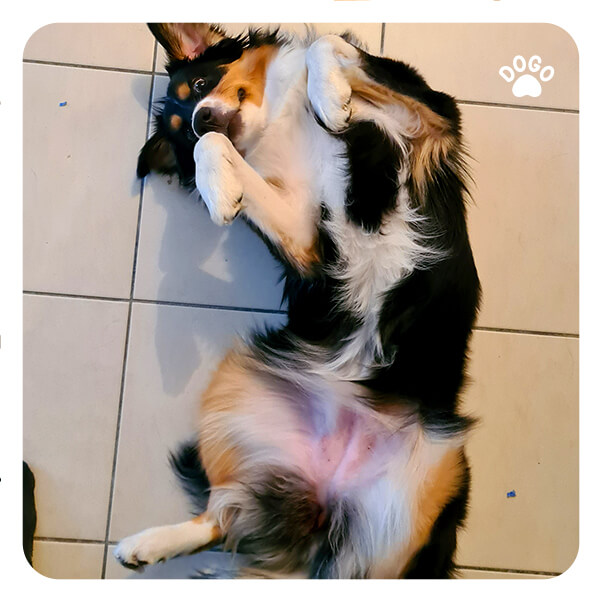
My dog Rolls on Their Back – Is That Normal?
Post Date:
July 18, 2024
(Date Last Modified: November 13, 2025)
Dogs roll onto their backs for many reasons ranging from simple comfort to signals aimed at other animals or people. Observing the rest of the dog’s posture and the context around the behavior helps clarify whether it is friendly, attention-seeking, or a sign of a medical problem.
Common Reasons Dogs Roll on Their Backs
One short rationale: Summarize the main motivations behind the behavior so readers can quickly identify likely causes.
Many dogs expose their bellies to solicit petting or attention, to show appeasement toward humans or other dogs, to scratch an itch or roll in an attractive scent, or simply because they feel relaxed and comfortable. If rolling is frequent—more than 3 episodes in a 30-minute span—it is more likely a communicative or habitual behavior than an isolated incident [1].
Reading the Body Language
One short rationale: Explain how accompanying signals distinguish friendly, anxious, or medically driven rolling.
Context and the rest of the dog’s body language help you tell the difference: a relaxed belly-up with soft eyes, floppy mouth, and a wagging tail usually signals friendliness, while tucked tail, pinned ears, rapid panting, or stiff limbs point toward anxiety or discomfort. Holding a loose belly-up posture for more than 10 seconds during calm interaction strongly favors relaxation and trust rather than a stress response [2].
Medical and Skin-Related Causes
One short rationale: Identify physical problems that can make rolling a symptom needing veterinary attention.
Parasitic irritation from fleas, mites, or ticks, allergic dermatitis, fungal skin infections, and localized pain can all provoke frequent or frantic rolling. For diagnostic clarity, veterinarians commonly collect 2–3 skin scrapings or hair plucks from affected sites to look for mites, fungal elements, or inflammatory cells [3]. Systemic supportive care for dehydrated or ill patients follows standard maintenance-fluid estimates around 60 mL/kg/day when clinically indicated [3]. When rolling is accompanied by open sores, hair loss, persistent scratching, or worsening redness it warrants prompt veterinary evaluation.
Learned and Reinforced Behaviors
One short rationale: Describe how owner responses and past reinforcement can create habitual rolling.
Dogs quickly learn what works. If a dog receives petting, treats, or animated attention within 2–3 seconds after rolling, the behavior is likely to be reinforced and repeated in similar contexts [4]. Social reinforcement from other dogs or from guests who laugh and lean in can also create a pattern. Identifying what happens immediately before and after rolling is the fastest way to detect whether the behavior is being learned and maintained by rewards [4].
Age, Breed, and Personality Influences
One short rationale: Cover how a dog’s age, breed tendencies, and temperament shape the likelihood and meaning of rolling.
Puppies tend to roll more during social play and greeting interactions, while older dogs may roll less often unless seeking relief from itch or pain. Puppies may roll 5–10 times per hour during intense play periods, whereas calm adult dogs typically roll only occasionally [5]. Certain breeds with naturally submissive or floppy demeanors may present belly-up more readily, and individual temperament (shy versus outgoing) strongly influences whether a roll is an invitation to touch or an appeasement signal.
When Rolling Is Normal vs When It’s Concerning
One short rationale: Provide clear criteria to decide if rolling is typical or a sign of a problem.
Use frequency, intensity, and associated signs to differentiate normal from concerning behavior. Occasional rolling during greetings or relaxation is normal, but repetitive rolling, rolling that is frantic or vocalized, or rolling paired with scratching, hair loss, limping, lethargy, fever, or changes in appetite suggests a medical or behavioral concern. Sudden new-onset rolling or a clear escalation in frequency over a few days also increases the likelihood that a veterinary assessment is needed.
| Scenario | Typical Signs | Concerning Signs | Suggested Action |
|---|---|---|---|
| Greeting/Attention | Loose body, soft eyes | Frantic pacing, vocalization | Ignore to avoid reinforcement |
| Play/Comfort | Quick roll, resumes play | Repeated, restless rolling | Redirect to toy or calm cue |
| Skin irritation | Localized redness or scooting | Open sores, severe scratching | Check skin; contact vet |
| Pain or neuro | Stiffness, guarded movements | Weakness, sudden change | Seek immediate veterinary care |
What to Do at Home Right Away
One short rationale: Offer immediate, practical steps owners can take to assess and respond safely.
- Observe and record when rolling happens, what happens right before and after, and any patterns in location or people present.
- Visually inspect the skin for fleas, flea dirt, wounds, scabs, redness, or wet patches; avoid aggressive probing of sore areas.
- Do not reward frantic or attention-seeking rolling with petting or treats; instead, calmly redirect to a sit or a toy, and reward the alternative behavior.
- Maintain routine grooming, regular flea/tick prevention as recommended for your area, and consider a soothing oatmeal bath if the skin is dry and intact.
Recording context and photographs or short videos of the behavior can be very helpful to a veterinarian or behaviorist later.
When to Seek Veterinary or Professional Help
One short rationale: List specific triggers that mean a vet or behaviorist should be consulted.
Seek veterinary care promptly if rolling is accompanied by signs of pain, open sores, swelling, fever, persistent or worsening skin disease despite home care, or sudden changes in mobility or behavior. If rolling co-occurs with aggressive displays, freezing, or other signs of severe fear, referral to a certified dog behaviorist is appropriate to manage risk and address underlying anxiety.
Training and Handling Guidelines
One short rationale: Provide humane techniques to manage, redirect, or encourage appropriate rolling and handling.
Use positive reinforcement to teach alternative, incompatible behaviors such as sit or down and reward those reliably. Teach an “off” or “relaxed” greeting cue and practice in low-distraction contexts, then gradually increase challenge. For dogs that are sensitive to handling, desensitization and counterconditioning in short, controlled steps improves tolerance for grooming, veterinary exams, and routine touch without increasing submissive or fearful rolling. Avoid punitive responses that can heighten anxiety, increase appeasement displays, or damage trust.
Prevention and Long-Term Management
One short rationale: Recommend strategies to reduce unwanted or harmful rolling through health and behavior maintenance.
Consistent parasite prevention, a skin-care routine tailored to your dog’s coat and skin sensitivity, and regular veterinary wellness checks reduce the likelihood that rolling stems from untreated medical problems. Mental enrichment such as regular walks, interactive toys, and structured play can lower attention-seeking rolling by meeting cognitive and physical needs. Keep household responses consistent so the dog learns predictable outcomes, and schedule periodic behavior check-ins or re-evaluations if patterns change.
Veterinary diagnostics and common tests
When rolling is suspected to have a medical cause, veterinarians typically combine history, physical exam, and targeted tests to identify the problem rather than treating empirically. A common approach includes 2–3 focused diagnostics such as skin scrapings for ectoparasites, cytology for bacteria or yeast, and a fungal culture when ringworm is suspected [1]. Flea-comb checks performed for 2–3 minutes over several body regions increase the chance of finding flea dirt when present, improving diagnostic yield [4]. Fungal cultures, when used, often require incubation and can take 7–14 days for definitive results, so clinicians will often start supportive therapy based on cytology and clinical signs while awaiting culture confirmation [3].
Common treatments and expected timeframes
Treatment depends on the underlying diagnosis but often follows predictable timelines. Effective topical or systemic flea control is typically maintained with products scheduled every 30 days (monthly) according to product labeling and veterinary guidance [4]. Superficial bacterial or yeast infections frequently respond to topical therapy within 7–14 days and to systemic antibiotics or antifungals within 10–28 days depending on severity and drug chosen [1]. For allergic dermatitis, multimodal management including allergen avoidance, medicated baths every 7–14 days, and targeted medications may be needed; many patients show measurable improvement by 2–6 weeks after initiating an appropriate plan [3]. When pain or neurologic causes are involved, initial stabilization and analgesia are provided immediately and a tailored plan is developed within 24–72 hours of assessment [3].
How to prepare for a veterinary appointment
Bring objective records to speed diagnosis: note the onset date, frequency (for example, how many times per day rolling occurs), recent treatments, and any environmental changes. Video recordings of 30–60 seconds showing typical rolling episodes and the 15–30 seconds before and after are often sufficient for clinicians to interpret body language and triggers [2]. If you have used over-the-counter flea products, record the product and the last administration date; many protocols require re-treatment intervals of approximately 30 days for sustained control [4]. Also list any medications and the animal’s weight in pounds and kilograms—accurate weight supports safe dosing decisions during the visit [3].
Behavioral therapy and what to expect from training
When rolling reflects learned or anxiety-driven behavior rather than disease, a structured training plan produces measurable change. Certified trainers and behaviorists frequently recommend short daily sessions of 5–10 minutes to build alternative behaviors, with progress reviews every 1–2 weeks during active reconditioning [2]. Counterconditioning and desensitization protocols typically follow incremental steps where the dog is exposed to a subthreshold trigger and rewarded for calm responses; many programs aim for incremental increases in tolerance over 4–8 weeks before moving to more challenging contexts [5]. Owners are often asked to keep a behavior log for 2–4 weeks so the trainer can quantify triggers, frequency, and context changes and adjust strategies accordingly [5].
Documenting progress and follow-up
Objective measurement helps determine whether interventions are working. For skin-related problems, veterinarians generally expect to recheck the patient within 7–21 days after initiating treatment to assess response and modify therapy if needed [1]. For behavioral plans, a 4–8 week window with weekly or biweekly adjustments is common before concluding whether a strategy is effective or whether referral to a certified applied animal behaviorist is needed [2]. If you start a new parasite-control product, monitor for decreased signs of rolling and pruritus over 2–4 weeks because environmental burdens and lifecycle dynamics can delay full clinical improvement [4].
When a specialist referral is appropriate
Referral to a veterinary dermatologist or a board-certified behaviorist is appropriate when primary measures fail or when diagnostics are complex. As a rule of thumb, consider dermatology referral if an allergic workup or advanced diagnostics are likely to require more than 4–6 weeks of staged testing, or if repeated empirical therapies over 2–3 months produce only partial responses [1]. Behaviorist referral is indicated when fear or aggression accompanies rolling or when a dog’s safety is a concern; many specialists schedule initial behavioral consultations with 1–2 follow-up sessions in the first month to create and refine a management plan [5].
Key takeaways owners can act on today
Document episodes with short videos and simple notes about frequency and triggers, perform a careful visual skin check for 2–3 minutes each session, and avoid rewarding frantic or attention-seeking rolling while reinforcing alternative behaviors. If signs suggest a medical problem—open sores, persistent scratching, worsening hair loss, fever, or sudden mobility changes—seek veterinary evaluation within 24–72 hours; otherwise, implement consistent training and preventive care and reassess over 2–6 weeks to judge progress [3].
Sources
- merckvetmanual.com — trusted clinical reference on veterinary dermatology and behavior.
- aaha.org — American Animal Hospital Association resources on behavior and body language.
- avma.org — veterinary diagnostic and supportive care guidance.
- vcahospitals.com — clinical notes on training reinforcement and common skin problems.
- wsava.org — international guidance on behavior, welfare, and juvenile development.
