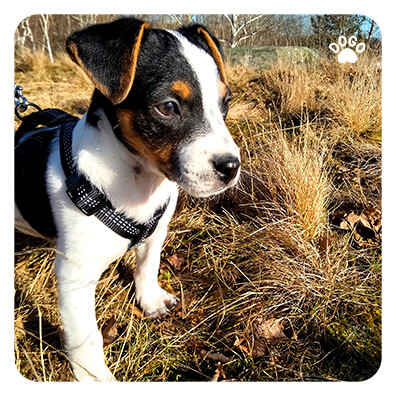
Dog House Training. Step by Step and Troubleshooting.
Post Date:
July 18, 2024
(Date Last Modified: November 13, 2025)
House training a dog requires consistent routines, clear signals, and coordinated household expectations to shape reliable indoor and outdoor elimination behavior.
Training objectives and terminology
Successful house training means the dog eliminates in preferred locations with predictable cues, and accidents decline to a level set by the household while the dog reliably responds to a chosen bathroom cue.
Define terms clearly: “house training” means teaching a dog where to eliminate and when; “crate training” means using a properly sized confinement space to restrict unsupervised movement; an “accident” is elimination in an undesired location; “marking” is small, typically vertical, scent-marking behavior; and a “signal” is any behavior the dog uses to indicate a need to eliminate. To set measurable goals, aim for fewer than 1 accident per week within 8 weeks of consistent practice, with the dog eliminating outdoors or on the designated surface on cue at least 80 percent of outings [1].
Preparation and essential supplies
Gather basic equipment and set household rules so every caregiver responds the same way to signals and accidents. Supplies that make consistent practice possible include a properly fitting collar and leash, a crate sized so the dog can stand, turn, and lie down comfortably, indoor pads or paper if used, an enzymatic cleaner for accidents, high-value treats for reinforcement, and a clicker if using marker training.
- Collar and leash
- Crate and bedding
- Indoor pads or paper (optional)
- Enzymatic cleaner
- Treats and clicker
Establish clear household rules such as permitted rooms, who handles outings, and a rotation schedule for primary caretakers. Create a training schedule that lists feeding times, bathroom outings, and supervised play periods so caregivers can track progress. For safe confinement, block off a few small areas of the home where the dog is allowed when unsupervised and ensure the crate is placed in an area used by the family for better social contact guidance [2].
Canine physiology and behavior basics
Bladder and bowel control develop with age and are influenced by size, health, and prior experience. A common rule of thumb is that a puppy can often hold urine approximately one hour per month of age, up to about 8 hours as control matures, with small breeds often having shorter intervals than large breeds [1].
Typical pre-elimination signals include circling, sniffing, pacing, whining, and heading to an exit or door; watch for a consistent sequence of behaviors that becomes the dog’s signal so caretakers can respond promptly. Learning is driven by immediate, consistent reinforcement: reward correct eliminations within seconds, and avoid physical punishment because it increases fear and can worsen indoor elimination problems [3].
Maintain hydration and regular feeding to create predictable elimination windows; maintenance water intake is roughly 50 mL/kg/day for most adult dogs, which helps estimate expected urine production when paired with feeding schedules [3].
Age- and situation-based timelines
Puppies require graduated freedom and milestone-based increases in unsupervised access: introduce small increments of freedom when the puppy achieves consistent elimination outdoors for a sequence of days, typically extending freedom over 2–4 weeks as reliability improves [4].
Adult and rescue dogs need a rapid stabilization period consisting of a predictable feeding and outing schedule, confinement when unsupervised, and close monitoring for the first 7–14 days to identify existing habits or medical issues before relaxing protocols [4].
Seniors commonly have medical contributors to accidents; if a previously trained older dog begins to have frequent accidents, seek medical evaluation promptly and expect that management may require more frequent outings and temporary confinement adjustments [1].
| Age category | Typical hold time | Initial outings per day | Freedom milestone |
|---|---|---|---|
| Puppy 8–12 weeks | 1–2 hours | 8–12 | Consistent 24–48 hours |
| Puppy 3–6 months | 3–4 hours | 6–8 | Consistent 2–3 days |
| Adult | 4–8 hours | 3–4 | Weekly reliability |
| Senior | Varies; often reduced | 4–6 (may increase) | Medical stability |
Step-by-step house-training protocol
Begin with a predictable feeding schedule, offering meals at set times so elimination can be anticipated. Most adult dogs do well on two meals per day, which creates predictable post-meal elimination windows to work from [2].
Take the dog to the chosen elimination location immediately after waking, after meals, after play or intense activity, and before long periods of confinement; for puppies, aim for outings every 2 hours, and for healthy adults target every 4–6 hours until habits stabilize [1].
Use a short phrase as a bathroom cue delivered when the dog begins to eliminate and reward within seconds with a treat and brief praise; delayed rewards reduce learning effectiveness. If an accident occurs, calmly interrupt if you catch it in progress and immediately take the dog to the correct spot to finish; clean the soiled area thoroughly with an enzymatic product to remove odor cues rather than punishing the dog, which can create fear and hiding of elimination [5].
Gradually increase freedom based on objective criteria: no accidents for 24–48 hours at the current freedom level before adding an extra 30–60 minutes of unsupervised time for puppies, or longer increments for adults, and continue to monitor signal reliability and accident frequency [4].
Crate-based training method
Select a crate size that allows the dog to stand, turn, and lie down without excess space so the area is not used for elimination; if needed, use a divider to adjust interior space. Place the crate in a family area where the dog feels part of household activity and link crate periods to the bathroom schedule so the dog learns that confinement is temporary and that elimination occurs on outings [4].
Introduce the crate in short, positive sessions with treats and quiet activity, increasing stay time gradually. For nighttime management, anticipate one brief outing for young puppies and adjust crate duration as the dog demonstrates the ability to sleep through increasing intervals without accidents; extend crate-free nighttime hours only after several consecutive nights without elimination in the crate [4].
Indoor-pad and paper training method
Place pads in a consistent, low-traffic location and keep them aligned with the desired cue and entry route so the dog learns a predictable path; use scent attractants only briefly because leaving strong indoor scents can make later outdoor transition harder. Provide the bathroom cue when the dog uses the pad and reward immediately to reinforce the association. To transition outdoors, move the pad progressively closer to the exit over days and then to an outdoor spot, rewarding the same cue when the dog eliminates outside so the behavior generalizes to the new surface [1].
Avoid reinforcing unlabeled indoor elimination by not cleaning up with visible attention and by using enzymatic cleaners to remove residual odor; limit pad use to a defined training period to reduce the chance of long-term indoor preference [5].
Outdoor-only and potty-spot training
Choose a consistent outdoor potty spot that is accessible year-round and condition the dog to it by using the same route, cue, and brief wait period; select a location with minimal distractions to help focus elimination behavior. For reliable conditioning, use the same cue phrase each outing and reward within seconds of successful elimination so the dog links the cue to the act [1].
Account for weather and travel by maintaining the same cue and pocketing quick treats for unpredictable outings. When using public spaces, respect leash laws and neighborhood rules while keeping outings consistent in timing and sequence to reduce anxiety-related accidents [3].
Accident response, cleaning, and record-keeping
Immediately remove the dog from the soiled area and take them to the correct location; avoid scolding, which is counterproductive. Use an enzymatic cleaner and allow it to sit on the surface for the product’s recommended contact time, typically about 10 minutes, to break down odor molecules rather than masking them with ammonia-based household cleaners that can encourage re-soiling [5].
Keep a log of elimination times, locations, and any signals to detect patterns; recording morning, midday, evening, and overnight events for two weeks will reveal trends for schedule adjustments and potential medical referral. Share this log with a veterinarian or behavior professional if accidents persist so they can correlate patterns with possible medical causes [2].
Troubleshooting common problems
Distinguish medical causes from behavioral problems: sudden onset of frequent accidents, straining, blood in urine, or large-volume incontinence warrants veterinary examination promptly rather than additional training alone [1].
For marking and territorial urine, restrict access to commonly marked vertical surfaces, use confined supervised outings, and consider temporary belly bands for males while addressing the underlying social or territorial triggers. In multi-dog households, isolate house-training to one dog at a time with separate scheduled outings and individual reinforcement to avoid social learning of unwanted habits [4].
If regression follows a household change, illness, or increased stress, revert to a more structured routine with increased supervision and shorter freedom increments and consult a certified behaviorist if separation anxiety or fear-based elimination is suspected [3].
Sources
- merckvetmanual.com — Veterinary clinical guidance and behavior summaries.
- avma.org — American Veterinary Medical Association resources on feeding and medical triage.
- aaha.org — American Animal Hospital Association recommendations on behavior and clinical care.
- wsava.org — World Small Animal Veterinary Association guidance on behavior and welfare.
- vcahospitals.com — Clinical hospital resources on cleaning, elimination disorders, and home care.