
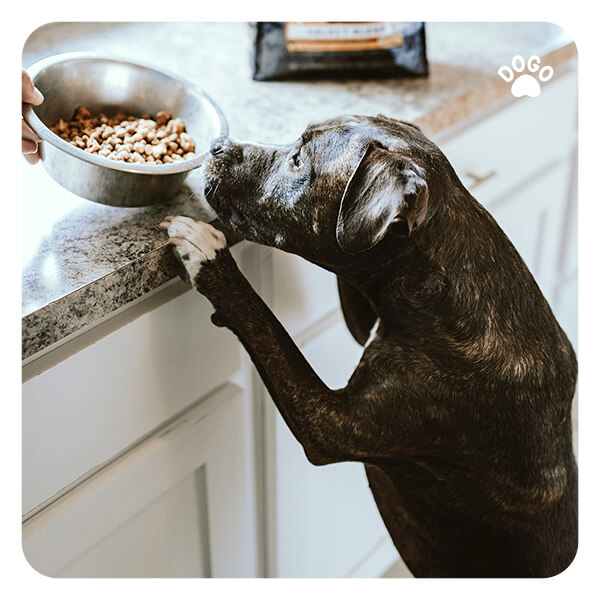
Dog Stealing Food? Teach Them Impulse Control
Post Date:
July 18, 2024
(Date Last Modified: November 13, 2025)
Dogs often take available food because of instinct, learned opportunity, or a medical or emotional reason, and managing the behavior requires both prevention and training.
Why dogs steal food — common causes and learning mechanisms
Food-stealing often develops because foraging and scavenging are strong instincts, and a single successful snack can create a rapid learned response: an available morsel can be taken within 1–2 seconds after a dog notices it, which reinforces the behavior if not corrected[1].
Reinforcement history is powerful: if a dog routinely receives attention, a dropped piece, or the forbidden item itself after trying, a pattern forms in as few as several repetitions to tens of trials depending on timing and reward value, making repetition and timing key to unlearning the habit[6].
Medical contributors—such as high appetite from endocrine disease, dental pain that changes chewing patterns, or age-related cognitive change—should be considered because clinical issues can present with increased scavenging or altered appetite; many medical differentials are covered in standard veterinary references and warrant a veterinary exam if the behavior is sudden or escalating[1].
Health and safety risks of food-stealing behavior
Some human foods are directly toxic: xylitol can cause hypoglycemia and liver injury in dogs at doses starting around 50 mg per kilogram of body weight, making even small amounts dangerous for small dogs and a medical emergency for all sizes[3].
Grapes and raisins have caused acute kidney injury in some dogs, with reported toxic events at varying doses; any ingestion should prompt toxin guidance because there is no reliably safe threshold for all dogs[3].
Choking and gastrointestinal obstruction are immediate risks: bones, large pieces of food, or nonfood items can occlude the airway or gut, and emergency clinics commonly report foreign-body obstructions as an urgent surgical problem for dogs of all sizes[5].
Consistent access to extra snacks and table scraps can also increase caloric intake and contribute to weight gain; studies and clinical guidance note that even a daily extra 1–2 ounces of high-calorie food per day can produce measurable weight gain over weeks in many dogs[5].
| Hazard | Approximate harmful amount | Common consequence |
|---|---|---|
| Xylitol | ≈50 mg/kg — hypoglycemia and liver injury[3] | Low blood sugar, vomiting, lethargy |
| Grapes/raisins | Variable; some reports at small amounts per kg — kidney injury[3] | Acute kidney injury |
| Cooked bones | Any size that splinters — obstruction/ perforation[5] | GI obstruction or laceration |
| High-fat table scraps | Large fatty meals or repeated small feedings — pancreatitis risk[5] | Vomiting, abdominal pain, pancreatitis |
Assess your dog: triggers, frequency and context
Start by recording when and where stealing happens; note whether incidents occur at counters, the dining table, in the kitchen, or from trash bins, and track the frequency for a week to establish a baseline—aim for simple counts like number of stealing attempts per day or per meal session[2].
Identify targets: classify whether your dog targets human food, accessible dog food, or garbage, and note whether the items are high-value (meat, cheese) or low-value (salad scraps), because value predicts persistence and will guide training progressions[6].
Watch body language: pre-steal signs often include focused staring, forward-leaning posture, rapid sniffing at a particular spot, lip-licking, or an increase in overall arousal; recording the antecedent behaviors helps tailor preventative strategies and training timing[1].
Immediate management: prevent access and reduce reinforcement
- Secure storage: keep food in closed cabinets or the refrigerator and use trash cans with locking lids or exterior bins to reduce opportunity[4].
- Barriers and supervision: use baby gates, counter barriers, leashes in the home, or confined areas while meals are prepared and eaten; supervised confinement reduces unsupervised trials and accidental reinforcement[2].
- Remove rewards: avoid giving table scraps as a consequence of attention; instead, teach alternative behaviors and prevent inadvertent reinforcement from dropped food or excited reactions by people[6].
When confinement is used, follow safe time guidelines: adult dogs typically tolerate crate periods of up to 2–4 hours while awake, but puppies and senior dogs need more frequent breaks and monitoring to avoid stress or physical harm[2].
Teach “Leave It”: stepwise cue training for inhibition
Begin with a low-value object or treat held in a closed hand, rewarding any brief look away; start with 2–3 second holds and reward the dog for calm disengagement before increasing duration to 10–15 seconds as reliability grows[6].
Once the dog reliably ignores the low-value item, introduce a visible but unreachable higher-value item and add the verbal cue “Leave it,” continuing to reward for choosing the offered reward; graduate temptation slowly over multiple sessions and locations[6].
Progress criteria typically include consistent successful leaves in 8–12 short sessions per context before increasing difficulty, and avoid accidental rewards by withholding any access to the forbidden item until a clean response is given[4].
Teach “Drop It” and trade-up strategies for safe releases
Practice “Drop It” with toys first: play briefly, offer a higher-value treat, and give the treat the moment the dog releases the object; initial training often uses rapid, repeated exchanges across 5–10 trials per session to build momentum[6].
When helping dogs release food, use a true trade-up: present a noticeably higher-value food and exchange immediately, reinforcing the release; trainers commonly advise several successful exchanges in a row before generalizing to higher-stakes items[6].
Shape quick releases by gradually reducing the delay between offering the trade and the reward; many dogs move from slow to rapid releases in a few days of targeted practice if sessions are frequent and predictable[4].
Build impulse control with structured exercises and games
Short, frequent sessions work best: schedule 5–10 minute training blocks, two to three times per day, and increase complexity over weeks rather than sessions to build durable self-control without overwhelming the dog[4].
Wait and delayed-eating drills are useful: ask for a sit or place and delay release to the bowl by starting with 2–3 seconds and building toward 30–60 seconds for reliable self-control in higher-distraction environments[6].
Implement “Nothing In Life Is Free” (NILIF) by requiring a simple cue (sit, down) before delivering food or attention; consistent application across 10–20 routine interactions per day helps integrate impulse control into daily life[4].
Generalize training to real-life situations and distractions
Practice in the actual locations where stealing occurs—kitchen counters, dining rooms, and near trash—and vary duration, distance, and the type of food; aim for multiple short practices per day until the behavior transfers reliably across contexts[6].
Introduce people and environmental distractions gradually: begin with a single household member and low-distraction settings, then add visitors, conversations, or outdoor environments while maintaining predictable cues and reinforcement schedules[4].
Use variable reinforcement once a behavior is established—rewarding unpredictably at a rate of roughly one in three to one in five correct responses—to maintain the behavior without continuous reinforcement and reduce cue dependency[4].
Household rules, consistency and caregiver coordination
Set clear, written family rules about who feeds the dog, what table behaviors are allowed, and where food may be left, and require all caregivers to follow the same protocols to avoid mixed signals that impede learning; consistent rules across caregivers are recommended by behavior professionals[2].
Assign roles—one person manages training sessions, another handles meal supervision—and plan meal times so the dog is less likely to scavenge between scheduled feedings; regular, predictable meals reduce opportunistic stealing driven by inconsistent feeding schedules[4].
If stealing is sudden, extreme, or accompanied by other medical signs such as vomiting, polyphagia, or lethargy, seek veterinary evaluation because underlying health issues can present with increased appetite or changing behavior[1].
Sources
- merckvetmanual.com — veterinary clinical and behavior references.
- avma.org — animal welfare, crate and confinement guidance.
- aspca.org — poison control and toxicology information.
- aaha.org — behavior and clinical practice recommendations for small animal care.
- vcahospitals.com — clinical articles on toxin effects, foreign bodies, and GI emergencies.
- apdt.com — applied training methods and behavior modification techniques.
