
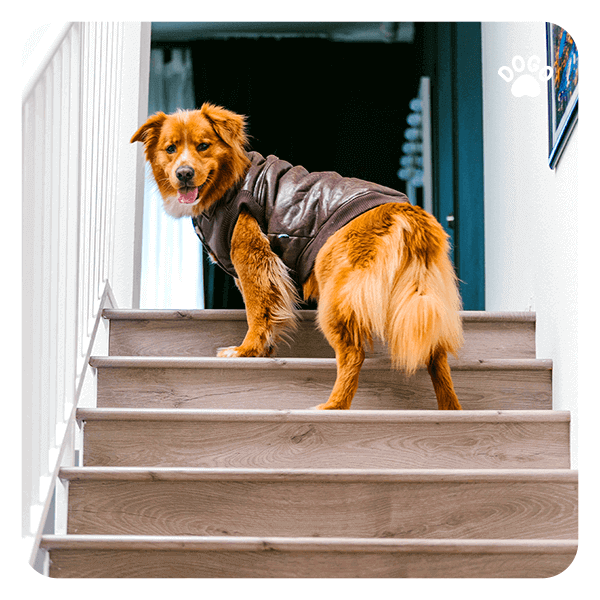
Stair Away From Me: Why Is My Dog Avoiding Stairs?
Post Date:
December 6, 2023
(Date Last Modified: November 13, 2025)
Dogs can stop using stairs for many different medical, sensory, behavioral, or environmental reasons, and noticing the pattern helps narrow the cause.
Signs Your Dog Is Avoiding Stairs
Owners can often tell avoidance from normal preference by watching specific behaviors and the context in which they occur. Common observable signs include hesitation at the base or top of a flight, backing away instead of ascending or descending, circling to find a different approach, and attempting to carry puppies or small items rather than climb with them.
- Hesitation or stopping at the first step
- Backing down, sliding, or slipping
- Circling or attempting to use an alternative route
- Carrying small dogs or objects instead of climbing
Track how often the behavior happens and whether it is getting worse: if avoidance episodes occur more than three times in a 24‑hour period or increase in frequency over three consecutive days, document date, time, and context for your veterinarian to review [1].
When observing, keep the situation safe: remove hazards, keep distance to avoid stressing the dog, and record short video clips from a fixed angle so gait and foot placement are visible for the vet.
When Avoidance Is a Medical Red Flag
Certain findings should prompt urgent veterinary evaluation rather than home management. Acute onset of paralysis, obvious non‑weight‑bearing lameness, or vocalization (yelping) with movement are red flags; seek emergency care immediately when these signs appear, especially if they develop suddenly within 24 hours [2].
Less dramatic but concerning signals include continued limping or reluctance to climb for 24–72 hours, progressive decline in stair ability, or new systemic signs such as persistent lethargy, inappetence, or fever — contact your regular veterinarian within that 24–72 hour window for an appointment [2].
Orthopedic Causes (Pain & Mobility)
Musculoskeletal pain is a common reason dogs avoid stairs because stairs amplify load and range‑of‑motion demands. Osteoarthritis may be present in adult and senior dogs and is reported to affect a notable portion of the population of pet dogs, often making stair climbing painful; owners should consider arthritis when avoidance is gradual and worse after activity [3].
Cranial cruciate ligament (CCL) injury commonly causes sudden hind‑limb lameness; dogs with an acute CCL rupture may become non‑weight‑bearing within 24–48 hours of injury and will often refuse stairs due to instability and pain [3].
Other orthopedic issues that change stair strategy include patellar luxation with graded instability (grades 1–4), hip dysplasia producing stilted gait, and growth‑plate injuries in young, rapidly growing dogs; these problems alter stride length and weight distribution, so a dog may hop, shuffle, or avoid stair use [3].
Neurological and Spinal Disorders
Spinal and nerve disorders can reduce strength, coordination, or proprioception and make stairs unsafe. Intervertebral disc disease (IVDD) is most commonly seen in chondrodystrophic breeds and often presents in middle‑aged dogs; onset tends to be between about 3 and 7 years of age in predisposed breeds [4].
Degenerative myelopathy typically starts later in life and commonly appears after roughly 8 years of age, causing progressive hind‑limb weakness and difficulty with stairs as proprioceptive deficits worsen [4].
Look for signs of neurologic dysfunction such as knuckling or delayed paw placement on the stairs, dragging toes, or an unsteady, swaying gait; these suggest nerve or spinal cord involvement rather than isolated joint pain [4].
Sensory and Cognitive Factors (Vision, Vestibular, Age)
Loss of vision or vestibular function can make depth perception and balance unreliable on stairs. Canine cognitive dysfunction becomes more likely as dogs age and can manifest as disorientation or hesitation on familiar routes such as stairs.
Prevalence estimates for cognitive decline vary, but studies report ranges roughly between 14% and 35% for dogs older than 8 years, and owners may notice increased stair avoidance or confusion around step edges in these cases [4].
Vestibular disease often causes sudden head tilt, circling, and severe ataxia; a dog with acute vestibular dysfunction may refuse stairs until balance improves [4].
Fear, Anxiety, and Learned Avoidance
Behavioral avoidance may begin after a frightening event on stairs (slip, loud noise) or when surfaces are slippery; the dog learns to avoid the stimulus and may generalize that fear to other staircases or to both up and down motions.
Short, regular desensitization and counterconditioning sessions can help rebuild confidence; start with very brief exposure and reward calm behavior — sessions of about 5–10 minutes, two to three times daily, are commonly recommended when beginning a program [5].
Differentiate fear from incapacity by checking for physical signs (pain‑related guarding, limping, collapsing) that indicate medical causes rather than purely behavioral ones [5].
Environmental and Design Issues
Stair geometry and surface traits can turn an otherwise healthy dog’s trip into a challenge; steep stairs, high rises, and narrow treads force excessive joint flexion and hip/knee loading. Poor lighting, reflective glare, abrupt changes from carpet to slick wood, and lack of traction contribute to avoidance.
| Feature | Problem | Suggested target | Why it helps |
|---|---|---|---|
| Rise (step height) | Too tall increases joint flexion | 7–8 in (18–20 cm) [3] | Lower rise reduces required hip and stifle flexion |
| Tread depth | Narrow treads limit paw placement | 10–11 in (25–28 cm) recommended [3] | Wider treads improve stability and foot placement |
| Surface traction | Slick surfaces cause slipping | Non‑slip strips or short‑pile carpet [3] | Improves grip and confidence |
Assessment Steps Owners Can Do at Home
Before the vet visit, perform a safe, structured assessment: note whether avoidance is worse when tired versus fresh, whether one limb seems weaker, and if the dog can navigate a single step versus a longer flight. Record at least one short video of the dog approaching and using (or refusing) the stairs from the side to show limb placement and timing [1].
Try simple range‑of‑motion checks while the dog is relaxed: gentle flexion and extension of the hip and stifle while watching for pain signals; do not force movement. Implement temporary, low‑risk modifications such as non‑slip stair treads, improved lighting, or carrying the dog for a single short flight to prevent injury until a professional evaluation is completed [3].
Veterinary Diagnostics and Treatment Options
The veterinary workup often starts with a full physical and neurologic exam; radiographs (X‑rays) are commonly obtained for orthopedic disease and may be followed by advanced imaging (MRI or CT) when neurologic deficits or spinal disease are suspected [4].
Pain management frequently includes NSAIDs and multimodal analgesia; clinicians tailor dosing to the patient, and supportive care such as fluid therapy is commonly prescribed when needed — typical maintenance fluid guidelines are in the range of 60 mL/kg/day, adjusted by the treating clinician [1].
Orthopedic surgery (for example, CCL repair) is indicated in many unstable stifles; referral to an orthopedic surgeon is appropriate for surgical planning, while progressive neurologic deficits often warrant neurology referral and advanced imaging [3].
Training, Rehabilitation, and Practical Solutions
Behavioral training for fear‑based avoidance uses counterconditioning and desensitization in graduated steps: start with one step at a time and pair calm behavior with high‑value rewards, increasing exposure only as the dog remains relaxed. Early sessions should be short; many programs recommend building up 5–15 minute sessions performed 2–3 times per week for physical rehabilitation phases [5].
Physiotherapy and hydrotherapy are effective adjuncts for strengthening and proprioception; clinical rehab often schedules sessions 2–3 times weekly, with at‑home exercises between visits. Simple home aids include a harness with lift support, portable ramps for one or two stairs, stair gates to prevent unsupervised attempts, and rearranging living spaces so sleeping areas and food are on a single level during recovery [5].
Prevention and Long-Term Management
Long‑term strategies focus on keeping joints and nerves as healthy as possible. Aim for a lean body condition (a target body‑condition score often around 4–5 on a 9‑point scale) because even modest excess weight increases joint forces; a controlled weight loss of around 10% can meaningfully reduce load on hips and stifles in overweight dogs [5].
Breed‑specific screening is useful: for example, hip and elbow radiographic screening at around 12 months of age is commonly recommended in susceptible breeds to guide breeding and early management decisions [3].
Maintain a monitoring plan with periodic reassessments and video records of stair use, and collaborate with your veterinarian and, when appropriate, a rehabilitation specialist to adjust exercise, weight, and home modifications over time [5].
Sources
- merckvetmanual.com — Clinical summaries on orthopedic, neurologic, and general small animal care.
- avma.org — Guidance on emergency signs, triage, and veterinary access.
- vcahospitals.com — Patient handouts and clinical overviews of orthopedic conditions and home modifications.
- ncbi.nlm.nih.gov — Peer‑reviewed studies and reviews on IVDD, degenerative myelopathy, and cognitive dysfunction.
- aaha.org — Guidelines and resources on pain management, rehabilitation, and behavior support.
