
Does My Dog Love Me? How to Tell
Post Date:
October 26, 2023
(Date Last Modified: November 13, 2025)
Dogs show consistent patterns of behavior that researchers and trainers use to assess attachment and affection, and those patterns are best interpreted through observable signals rather than projecting human feelings onto the animal.
What “love” means for dogs — defining canine affection
Scientists and applied behaviorists separate attachment, social bonding, and anthropomorphic “love” by using operational definitions tied to observable behavior and physiology. Researchers often operationalize attachment with three observable markers: proximity-seeking, secure-base use (the dog exploring more when the owner is present), and distress on separation[1].
That framing reduces projection: “attachment” describes consistent patterns of preference and comfort with a particular human rather than a claim about humanlike subjective feeling. The limits of inference remain important because self-report is impossible and some cues (for instance, leaning for warmth) can serve multiple functions.
Core body-language signals of affection
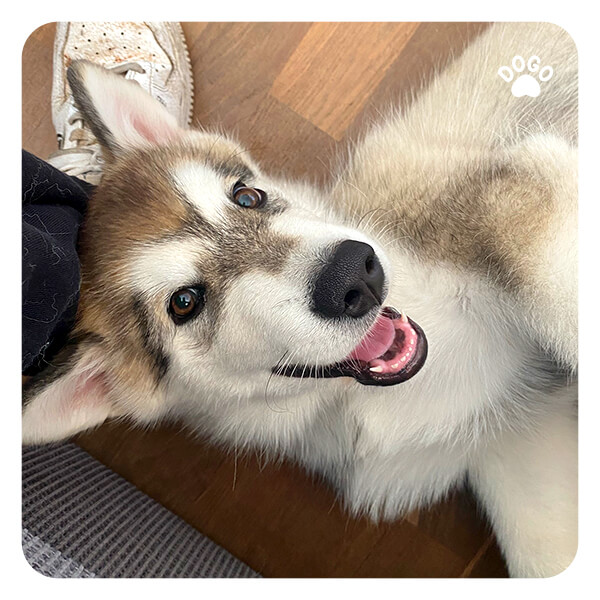
Several postures and expressions reliably indicate positive social intent when interpreted in context: broad, relaxed mouth; soft eye contact; play bows; leaning against a person; sustained proximity; and gentle pawing. When these behaviors are paired with relaxed breathing and a wag that biases to the right side of the body, researchers generally read them as affiliative rather than defensive or fearful[2].
| Signal | What it looks like | Typical meaning | When to be cautious |
|---|---|---|---|
| Relaxed mouth & soft eyes | Lips loose, blink rate normal | Comfort and calm social interest | If panting heavily, may indicate heat or stress |
| Play bow | Front end down, rear up | Invitation to play or friendly intent | Not a substitute for boundaries with fearful dogs |
| Leaning / nudging | Body pressure against a person | Seeks proximity and contact | Could be attention-seeking for food or movement |
| Tail wagging (contextual) | Loose wag vs. stiff twitching | Loose wag commonly affiliative; stiff often arousal | High, stiff tail with rapid movement suggests arousal |
Greeting and separation behaviors
Greeting intensity is a measurable indicator of attachment: a genuinely attached dog often shows a clear, short-lived peak of excitement when the owner returns. Greeting excitement tends to peak in the first 30–60 seconds and then settles into relaxed contact or activity for many dogs, depending on routine and context[3].
Conversely, separation distress shows through persistent vocalization, destructive behavior, or elimination when left alone; these behaviors differ from independence, which includes relaxed behavior and low arousal during typical absences. Context matters: a long or irregular absence, change of environment, or routine can amplify behaviors that look like distress.
Attachment and proximity-seeking patterns
Repeated choices to be near a particular person — following from room to room, choosing that person’s lap or couch space, or preferring to walk on the side closest to that person — are durable indicators of a bonded relationship because they reflect stable preference rather than a single learned cue.
Attachment-style research adapted from human protocols finds patterns analogous to secure, anxious, and avoidant profiles in dogs: secure dogs use the owner as a secure base to explore, anxious dogs show exaggerated proximity-seeking, and avoidant dogs limit contact even when stressed. Observing which pattern appears across multiple situations gives the best read on the relationship rather than one-off behavior.
Social communication: vocalizations and touch
Vocalizations carry distinct meanings in context: a short, soft sigh or low whuffle often accompanies relaxation and contentment when paired with soft body language, while repeated high-pitched whining more commonly indicates arousal, frustration, or solicitation for attention. Bark types vary widely by breed and situation and must be read in context with posture.
Touch patterns matter: leaning and gentle pawing during relaxed moments typically indicate affection or comfort-seeking, while persistent licking can be affiliative but also a displacement or appeasement behavior if the dog shows other stress signs. Tone and context change interpretation, so consider movement, proximity, and preceding events.
Physiological evidence of bonding
Physiological measures support behavioral indicators: studies of human-dog interaction report increases in oxytocin associated with mutual gaze and friendly petting, with measurable rises appearing within about 30 minutes of sustained positive interaction in experimental settings[4].
Calming contact and predictable handling can reduce heart rate and cortisol responses in dogs exposed to mild stressors; some controlled studies report modest heart-rate reductions on the order of several beats per minute after affiliative handling in laboratory conditions[4]. These biological signals are supportive evidence rather than proof of subjective feelings.
Behaviors that look like love but aren’t
Not all proximity or attention equals affection. Food-driven attention, crate-trained routines, or responses to cues that have been reinforced with treats can look like attachment but are learned contingencies. Habitual behaviors such as jumping for attention can persist without underlying social bonding.
Anxiety-driven clinginess is different: a dog that follows everywhere but freezes, pants, or shows other stress signs is more likely to be anxious than securely attached. When clinginess coexists with destructive behavior or toileting in the house, professional behavior assessment is advisable.
How breed, age and individual history affect expressions of affection
Breed tendencies influence how affection is expressed; some breeds were selected for close cooperation with humans and show more proximity-seeking behaviors, while others were bred for independent work and can be more reserved. These tendencies shift the baseline for interpretation rather than the underlying capacity for attachment.
Puppies and adolescents often show higher solicitation behavior and play, while many adult dogs settle into steadier patterns and seniors may seek more contact as mobility or senses decline. The puppy socialization window is roughly 3–14 weeks, and experiences in that period shape later sociability and comfort with humans[1].
Rescue dogs or dogs with inconsistent care histories may display avoidant or hyper-vigilant behavior that masks attachment; in many cases, predictable routines and gentle positive interactions help rebuild confidence over weeks to months.
Ways to strengthen and measure your dog’s bond with you
Practical actions that deepen attachment focus on predictable care, positive reinforcement, and shared, cooperative activities. Regular interactive play and short training sessions build communication and mutual reward, while reliable feeding, exercise, and calm handling establish trust.
- Use short training sets of 5–10 minutes, two to three times daily, to reinforce cooperation and provide predictable, positive interactions[5].
- Provide consistent routines for walks and feedings so the dog learns what to expect and can rely on you.
- Practice calm, responsive handling during stress (soft voice, slow movements) and reward voluntary calm behaviors to strengthen the secure-base association.
- Measure changes over time: more relaxed greetings, longer comfortable proximity, and decreased separation distress are practical signs of a deepening bond.
Simple daily checks to monitor bond strength include observing whether the dog chooses to be near you during downtime, whether greetings settle quickly into relaxed contact, and whether the dog seeks comfort from you during mild stressors rather than exhibiting escape or freezing patterns.
Sources
- merckvetmanual.com — summary of behavioral definitions and socialization guidance.
- vcahospitals.com — clinical notes on body language and common behavior signs.
- avma.org — statistics and guidelines related to pet behavior and welfare.
- ncbi.nlm.nih.gov — peer-reviewed studies on oxytocin, heart rate, and physiological measures in human-dog interaction.
- aaha.org — recommendations for behavior modification and practical training session structure.
